01 · The VOC Emission Control Problem
Virtually any chemical that can vaporize and remain in the atmosphere must be considered a pollutant — excluding those that constitute normal atmospheric composition. The question is whether it can be completely removed or controlled within concentration limits that are not harmful to human beings and nature. Limits are also set against sustainability goals of climate change and environmental protection. Whatever the technology used, emissions must comply with these limits — strictly adhered to in Europe, USA, and Japan.
Two approaches to the problem
Process modification
Changing or modifying the process chemistry and processing steps to reduce VOC generation at source.
End-of-pipeline treatment
Treating the exhaust stream after it leaves the process to meet emission standards without changing the upstream chemistry.
End-of-pipeline: two types
Destruction — converts pollutants to CO₂ / water to meet compliance. Nothing is recovered.
Recovery & recycle
Returns pollutants to the process or recovers them for use elsewhere — turning a liability into an asset.
Three broad technology categories
1 · Oxidation systems
Thermal or catalytic. Must operate below LEL, always require supplemental fuel (NG or LPG), and need thermal recovery — recuperative (40–70%) or regenerative (up to 95%). Achieves 95%+ destruction, but increases CO₂ / GHG output and eliminates any chance of solvent recovery.
Direct flame (flares) — Simplest and cheapest to install; highest auxiliary fuel cost.
Recuperative — Heat recovery limited to 40–70% to prevent auto-ignition in the exchanger.
Regenerative (RTO) — Multiple ceramic beds; heat recovery up to 95%.
2 · Reactive absorption
Converts pollutants into a saleable or disposable compound via liquid-phase reaction. Examples: formaldehyde → urea pre-condensates; H₂S / SO₂ → caustic soda; NOx → ammonia. Can reach non-detectable emission levels, but is chemistry-specific rather than general-purpose.
3 · Physical systems
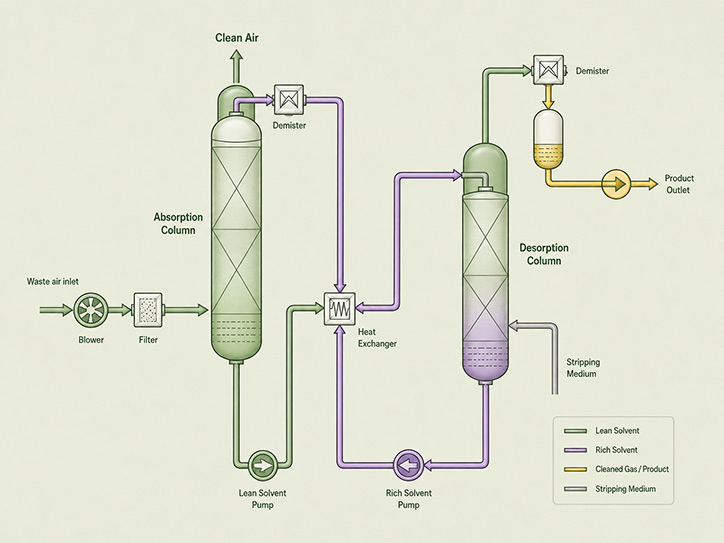
Our approachCapture VOCs without destroying or chemically altering them. A high-boiling absorbent dissolves VOC from the gas stream, then releases it in a stripping step for condensation and reuse.
Enables recovery. Runs at lower energy cost. Works across a broad range of chemistries.