What is Genosorb® VOC recovery?+
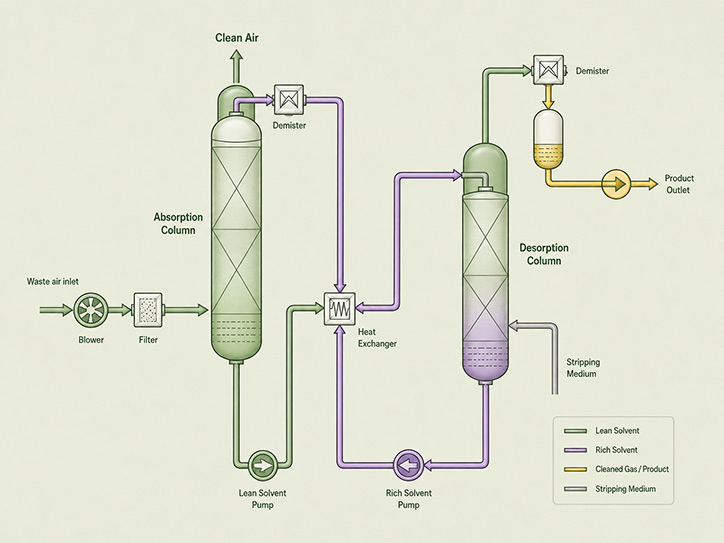
It is a physical absorption process. VOC-laden gas passes through an absorber where a liquid Genosorb® absorbent dissolves the solvent out of the gas. The loaded absorbent is then heated in a stripper, the released VOC is condensed as a recoverable liquid, and the regenerated absorbent is cooled and recycled to the absorber.
Which solvents can be recovered?+
Both polar and non-polar solvents, including acetone, MEK, MIBK, methanol, ethanol, isopropanol, ethyl acetate, butyl acetate, toluene, xylene, hexane, heptane, tetrahydrofuran, methylene chloride, acrylonitrile, styrene and carbon disulphide. Genosorb 300 is used for polar solvents and Genosorb 1843 for non-polar, aromatic and chlorinated solvents.
What recovery efficiency can be achieved?+
Genosorb systems are designed for 95–99.9% recovery. CCDC installations have achieved over 99% recovery on acrylonitrile and methylene dichloride streams, and around 90% on multi-point methanol and carbon disulphide streams.
How is VOC recovery different from thermal oxidation?+
Thermal and catalytic oxidisers destroy the solvent, need supplemental fuel such as natural gas or LPG, and add CO₂ emissions. Genosorb recovers the solvent so it can be returned to production, turning an emission-control cost into a material saving.
Can low-concentration, high-volume streams be treated economically?+
Yes. For streams of 10,000–200,000 m³/hr at only a few hundred to a few thousand ppm, a rotary concentrator is added ahead of the Genosorb unit. It raises concentration by up to 30×, so a 100,000 Nm³/hr flow reaches the recovery plant as 5,000–7,000 Nm³/hr, cutting equipment cost by 75–85%.
Which industries use Genosorb VOC recovery?+
Chemicals, specialty chemicals, pharmaceuticals, petrochemicals, flexible packaging, gravure printing, paints, coatings, inks, adhesives, automotive, textiles, battery manufacturing and semiconductors.
What gas flows has CCDC designed for?+
Reference installations range from a compact 100 Nm³/hr hexane recovery unit to gravure-printing streams above 100,000 Nm³/hr, including a carbon disulphide system scaled up 500× from pilot to 20,000–45,000 Nm³/hr.
How do I get started?+
Request a feasibility study. Share the solvent(s), gas flow, VOC concentration and operating conditions, and CCDC will prepare a preliminary recovery evaluation. Contact voc@ccdcindia.com or +91 98401 42990.